Words Klondike : Associations
- 4.7
- Rating
- 100.00K
- Installs
- Free
- Price
 Analysis by App-foxy
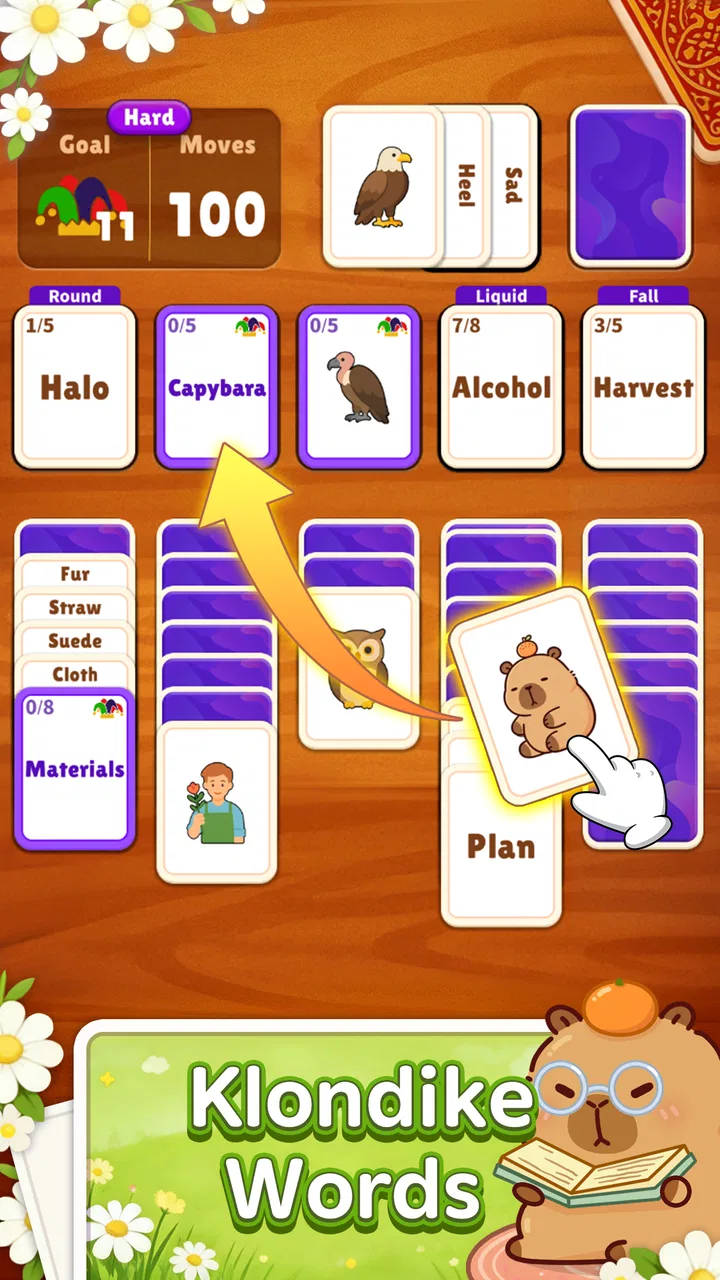
Words Klondike: Associations is a word game from Higgs Studio that mixes card sorting with word-association puzzles. I found the basic idea easy to understand: cards need to be arranged into categories while the layout follows a Solitaire-style challenge. That combination gives it a different feel from a standard crossword, an anagram board, or a traditional Klondike card game. You are not simply searching for one correct word; you are trying to recognize relationships between several words while also managing the order in which cards become available.
That makes the game appealing when I want something quiet and mentally active rather than fast or competitive. A short session can work as a break between tasks, while a longer session gives me time to think through less obvious connections. It is free to start, rated for Everyone, and the listing shows a 4.6 average from around 3.8 thousand ratings. Those details suggest that it has already found an audience, but the real question is whether the unusual word-and-card combination offers enough value for your particular style of play.
How the word-and-card format feels in everyday play
The central loop is deliberately simple. Cards appear as words, and the challenge is to sort them into meaningful groups while dealing with the restrictions created by the Solitaire arrangement. At first glance, that sounds like a basic matching exercise. In practice, the card layout changes how I approach each clue. A word may clearly belong to a category, but the card I need might be covered, placed in an inconvenient position, or useful only after another move.
You May Also Like

 Blood Strike: 2.5 Anniversary
Blood Strike’s Loadouts Turn Every Drop Into a Tactical Gamble
A close look at Blood Strike’s custom loadouts: how fast access to signature weapons reshapes its battle royale rhythm, rewards preparation, and narrows the gap between fights.

 Pandora - Music & Podcasts
Pandora’s Music Is Easy to Start, but Harder to Recover
Pandora’s strength is its low-effort path from a seed to a station. Its weak spot is how much confidence it asks you to place in connection, setup, and quiet recovery.

 8 Ball Pool
 Is Built on Rivalries, Rematches, and Routine
A close look at the rivalries, rematches, shared routines, and unanswered safety questions that turn a quick pool match into a persistent mobile community.

 Samsung Music
’s Quiet Strength Is Playing What You Already Own
Its reach comes less from spectacle than from dependable access to a personal library. That simplicity is both the app’s strongest retention engine and its ceiling.

 AccuWeather: Weather Radar
AccuWeather Review: A Quick, Clear Forecast for Everyday Decisions
For everyday plans, the best forecast is the one you can understand quickly. AccuWeather makes rain timing, radar, and local conditions easy to act on, with a few trade-offs.

 Hill Climb Racing
Why Hill Climb Racing Still Turns Crashes Into One More Run
A tiny car, a bumpy hill and one more upgrade: Hill Climb Racing keeps resurfacing because its simple chaos makes every near-miss feel personal.
More From Our News Desk
View All News


This is where the game separates itself from ordinary word puzzles. In a crossword, the crossing letters steadily narrow the answer. In an anagram game, the available letters usually define the limits. Here, I have to combine vocabulary, association, and planning. The best move is not always the category that seems most obvious. Sometimes it is the move that exposes another card, keeps the arrangement manageable, or avoids leaving an awkward word stranded later.
I like that the game can make familiar words feel less certain. A card may fit more than one possible theme, or it may look like an easy answer until the remaining cards reveal a better grouping. That creates a useful second layer of thought. I am not only asking, “What does this word belong with?” I am also asking, “Which interpretation helps the whole board?”
The Solitaire influence gives the experience a steady rhythm. I can scan the visible cards, identify likely relationships, and then decide whether to act immediately or hold back. This is more relaxed than a timed word game, but it is not completely passive. The layout encourages careful sequencing, especially when a move can affect which cards become accessible next.
Why the format works better than the short description suggests
The most interesting strength is the way it turns vocabulary into a planning tool. A player with a large vocabulary may recognize categories quickly, but that does not automatically guarantee a smooth solution. Someone with average word knowledge can still succeed by observing the board and making cautious moves. That balance makes the game less intimidating than a demanding dictionary-based puzzle.
A practical tip is to avoid committing to the first category that comes to mind. I get better results by first scanning all visible cards and noting words that seem unusually specific. Those often provide stronger anchors than broad words that could fit several groups. Once an anchor is identified, the surrounding cards become easier to judge, and I am less likely to force a weak association simply because it is available.
Another useful habit is to think one reveal ahead. Before moving a card, I consider what the move is likely to uncover and whether that new card could be more valuable than the category I am currently building. This is a small change in approach, but it turns the game from casual tapping into a compact logic exercise. It also helps reduce the frustration of reaching a late position with several plausible but incompatible choices.
The game is particularly suitable for players who enjoy word puzzles but want something less rigid than a crossword. It does not require writing answers into a grid or memorizing a long list of clues. The cards provide immediate visual structure, while the associations leave room for interpretation. That combination can feel more approachable on a phone, especially when I only have one hand free or a few minutes to spare.
Using it as a short break instead of a full gaming session
A realistic use case is a commute, a waiting room, or a short pause during the afternoon. I can open a puzzle, examine the visible words, and make progress without needing to remember a complicated story or control scheme. The mental effort is enough to interrupt a repetitive routine, but the format does not demand the physical attention of an action game.
It also works well as a low-pressure evening activity. The category element keeps my mind engaged, while the card structure provides a clear boundary around the task. If you prefer games that can be paused mentally without losing a large amount of progress, this style is more convenient than a real-time multiplayer word challenge.
There is a trade-off here. Players who enjoy constant novelty, dramatic goals, or a strong sense of progression may find the core loop restrained. The appeal depends heavily on whether sorting words and planning card moves is satisfying in itself. If that foundation does not interest you, the free entry point will not change the experience enough to make it compelling.
Cost, value, and the limits of the free starting point
The game is free to download, so the initial decision is straightforward: you can try the central word-association and Solitaire format without paying an entry fee. That matters because this is a niche combination. It is difficult to know from a short description whether you will enjoy balancing category recognition with card order, and free access lets you test that relationship directly.
Optional in-app purchases are listed from $1.99 to $99.99 per item. I would treat those purchases as a separate value decision rather than part of the basic admission price. The free starting point is useful for discovering whether the puzzles suit you, while paid items may appeal only if you already enjoy the routine and want whatever optional benefits or content are available through the game. I would not spend simply because a difficult board feels inconvenient; first, I would check whether changing my move order solves the problem.
That distinction is important for a puzzle game. The value of the free version comes from the core activity itself: recognizing associations, organizing cards, and working through the Solitaire-style layout. If that loop remains enjoyable without spending, the game can be a worthwhile casual download. If you need purchases to make the experience tolerable, the underlying format probably is not a good match for you.
The current version is 1.13.0, and the minimum operating-system requirement is Android 6.0. For a reader using an older Android device, that requirement is worth checking before setting expectations. On a compatible phone, the game is positioned as an accessible word title rather than a graphically demanding release. Its Everyone age rating also makes the concept broadly approachable for families, although individual enjoyment will still depend on vocabulary and patience.
I would be careful about comparing the purchase range with the price of a conventional premium word game. A one-time paid title has a clearer cost boundary: pay once, then use the complete product under its stated model. A free game with optional purchases offers a lower barrier to entry but can make long-term value harder to judge until you have played enough to understand what you actually need. For Words Klondike: Associations, that means the sensible approach is to play first, decide how often you return, and only then consider whether any purchase feels justified.
Where the game delivers genuine value
The strongest value is its combination of accessibility and mental variety. The rules are easier to grasp than those of many strategy games, but the associations prevent the experience from becoming a purely automatic card exercise. I can approach a board through language, through visual organization, or through cautious planning, depending on what feels most useful at the moment.
It is also a good fit for shared casual play. One person can suggest a category while another watches the card arrangement and points out a safer move. Because the game is based on words rather than reflexes, it can support conversation instead of shutting it down. That makes it more suitable for relaxed social use than a game that requires constant concentration on rapid inputs.
A less obvious benefit is that the format exposes how differently people interpret the same word. When two possible categories seem plausible, discussing the relationship can be as interesting as making the move. This is especially useful if you enjoy language casually rather than competitively. The game can become a small exercise in explaining why words belong together, not just in selecting a button.
There is also a practical learning angle, though I would not treat it as a formal vocabulary course. The puzzles encourage attention to word relationships, broad meanings, and category boundaries. A player may become more comfortable with synonyms, themes, and contextual links through repeated play. Still, the experience is best understood as entertainment with a language component, not as a structured educational tool.
Trade-offs that may affect your decision
The first limitation is that association puzzles can feel subjective. A crossword usually gives you a visible framework for why an answer is correct. In a category-based word game, the intended relationship may not always be the one I would naturally choose. When that happens, the challenge can feel less like deduction and more like guessing the designer’s grouping. Players who prefer precise, rule-driven puzzles should keep that possibility in mind.
The second issue is repetition. The card-and-category structure is the reason to play, but it is also the boundary of the experience. If you need a campaign, character development, changing mechanics, or a wide range of puzzle formats, this game may seem narrow after the initial novelty fades. It is better suited to people who enjoy refining their approach to a familiar system than to players who expect every session to introduce a new type of challenge.
Difficulty can also be uneven from a personal perspective. A category that is obvious to one player may be obscure to another because word familiarity is highly individual. That is not necessarily a flaw, but it means the game may alternate between satisfying breakthroughs and moments where the intended link is hard to see. I find it more enjoyable when I treat those moments as prompts to inspect the whole board rather than as tests of vocabulary alone.
The Solitaire structure introduces another trade-off: a clever association is not always the best immediate action. Players who instinctively select the most obvious group may occasionally create a less helpful arrangement. The game rewards restraint, but that can be frustrating if you prefer direct answers and quick completion. My advice is to pause before each move and identify which card is acting as the board’s bottleneck. Clearing that card may matter more than finishing the easiest category.
The purchase model deserves similar caution. The game is free to start, but the presence of optional items means that long-term value depends on your spending habits and tolerance for the free experience. I would recommend setting a personal limit before buying anything, especially if you tend to make small purchases impulsively during difficult puzzles. The listed range reaches from $1.99 to $99.99 per item, so the difference between a modest experiment and a substantial purchase is significant.
Another reason to skip it is if you want a pure card game. Despite the Solitaire presentation, the main appeal is not traditional card strategy. The words and their relationships are central, so someone looking for classic Klondike rules may prefer a dedicated Solitaire app. Conversely, a crossword fan who dislikes card layouts may find the presentation distracting. This game makes sense precisely for the overlap between those two interests.
Who will get the most from the free download
I would recommend it first to casual word-game players who enjoy sorting, grouping, and spotting connections without the pressure of a timer. It is also a good candidate for people who have grown tired of standard anagrams and want a little more planning in each puzzle. The Solitaire arrangement gives familiar vocabulary a different purpose, which is enough to make ordinary words feel newly useful.
It suits players who like to think before acting. If you enjoy examining a board, comparing several possible moves, and accepting that the best answer may require preparation, the format has real appeal. The game is less suitable for someone who wants immediate feedback after every tap or who finds ambiguous categories irritating.
Families may appreciate the Everyone rating and the easy-to-explain premise. A parent and child can look at the visible words together, discuss possible groups, and decide which card should move first. The main caveat is that vocabulary levels may differ sharply, so the experience is likely to work best when players cooperate rather than compete over speed or correctness.
It can also serve as a gentle alternative to scrolling. Instead of opening a demanding game during a short break, I can use the board as a focused activity that still leaves room for conversation or background music. That is a modest benefit, but it is one of the clearest reasons to keep a game like this installed: it fills small pockets of time without requiring a major commitment.
On the other hand, I would skip it if your priority is a large variety of modes, a deep narrative, or a one-time purchase with a clearly bounded cost. I would also look elsewhere if you want competitive leaderboards, fast reactions, or a strict word-definition challenge. The game’s identity is narrower and calmer than those alternatives, and its value depends on enjoying that narrow focus.
How it compares with familiar alternatives
Compared with a crossword, this game is more visual and less dependent on filling a fixed grid. You do not need to manage crossing letters, but you do need to evaluate broader relationships and card order. Compared with an anagram game, it offers more strategic planning and less emphasis on rearranging letters. Compared with traditional Solitaire, it adds a language puzzle that changes the reason behind each move.
Those comparisons also reveal when another option is better. Choose a crossword when you want clues with a more formal structure and a stronger sense of deduction. Choose an anagram title when you prefer quick rounds built around spelling and letter manipulation. Choose classic Solitaire when the pleasure comes from card sequencing alone. This game is the better fit only when the combination itself sounds appealing.
The developer, Higgs Studio, has positioned the release in the word category rather than presenting it as a conventional card title. That is a useful way to understand the experience: the cards are the framework, but the associations provide the substance. If you approach it expecting a normal Solitaire clone, you may judge it by the wrong standard and miss what it is trying to do.
My buy-or-skip verdict
My recommendation is to try the free version if you enjoy word relationships and relaxed card puzzles. The entry cost is low because there is no purchase required to begin, and the unusual format gives it a clear reason to exist beside crosswords, anagrams, and ordinary Solitaire. I especially like the way a simple category decision can become a sequencing problem once the card layout is taken into account.
I would not call it an automatic recommendation for every word-game fan. Its categories may sometimes feel open to interpretation, its core loop may become familiar, and the optional purchase range means you should judge paid value carefully rather than assuming that spending will improve the experience. The game is most rewarding when the free activity already feels satisfying and purchases remain optional rather than necessary.
For me, the deciding question is simple: do you enjoy pausing over a word, considering several possible relationships, and then choosing a card move that helps the whole board? If yes, Words Klondike: Associations offers a thoughtful twist on casual mobile word play. If you want strict clues, rapid rounds, or traditional Solitaire without language puzzles, I would skip it and choose a more specialized alternative.
Overall, I see it as a focused, approachable game for small breaks and quiet concentration. Its best idea is not merely placing words into groups; it is making those groups interact with card order. That gives the free download enough personality to deserve a trial, while the balanced choice is to keep playing only if the association-and-planning loop continues to feel rewarding. The free starting point is the real test of value: enjoy the core puzzle first, then decide whether the game earns a lasting place on your phone.
FAQs for Words Klondike : Associations
01What is Words Klondike: Associations about?
Words Klondike: Associations is a word puzzle game that challenges players to form connections between different words. It combines elements of strategy and vocabulary, requiring players to think creatively to solve levels. The game's unique approach to word association makes it both educational and entertaining for all age groups.
02Is Words Klondike: Associations free to play?
Yes, Words Klondike: Associations is free to download and play on both Android and iOS devices. However, like many mobile games, it offers in-app purchases. These can enhance gameplay by providing hints or unlocking additional levels, though they are optional and not necessary to enjoy the full experience.
03What are the system requirements for Words Klondike: Associations?
For Android users, Words Klondike: Associations requires Android version 5.0 or higher. iOS users need to have iOS 10.0 or later. The game is lightweight, so it does not demand a lot of storage space, making it accessible to most smartphone and tablet users without needing the latest hardware.
04Can I play Words Klondike: Associations offline?
Yes, Words Klondike: Associations can be played offline, making it a great option for those who want to enjoy the game without an internet connection. This feature is particularly useful for commuting or traveling, allowing players to continue solving puzzles without interruptions.
05Is Words Klondike: Associations suitable for children?
Words Klondike: Associations is suitable for children, as it promotes vocabulary development and critical thinking. The game does not contain any inappropriate content, making it a safe choice for young gamers. It can be an excellent educational tool for parents looking to engage their children in a fun and productive way.
Pros
- Engaging word puzzles boost vocabulary.
- Visually appealing design enhances gameplay.
- Regular updates with new levels.
- No intrusive ads during gameplay.
- Offline mode available for travel.
Cons
- Limited hints can stall progress.
- Occasional lag on older devices.
- In-app purchases for extra features.
- Repetitive music can annoy some users.
- High battery consumption during play.

Words Klondike : Associations
Gallery